

When Truth Is Rejected: Apollo, Artemis & Algorithms

I didn’t expect to spend time last week defending whether the Holocaust happened. But here we are.
Last week, I was both shocked and overwhelmed by the number of comments on my LinkedIn article about how AI is a powerful new tool being used by Holocaust deniers.
These comments were not just disagreeing with my historical assessment.
They disagreed with the entire historical record about the Holocaust. They insisted the mounds of historical evidence don’t exist, or that it was fabricated.
This onslaught of sophisticated comments was aimed at refuting the Holocaust. They argued that “what happened to the Jews during WWII” was “a fabrication” and that instead of six million Jews being murdered, “only 270,000” Jews died. Other commenters accused Jews of “killing far more people in Palestine,” and that Israel “was an illegal state,” and that the establishment of the state of Israel was “The biggest betrayal in human history.” To them, the Holocaust is a Jewish-inspired talking point, a manipulation, a lie told by people with an agenda.
These weren’t just naïve or uneducated folks repeating some simple-minded conspiracy theory. They were highly educated, seemingly intelligent people employed as developers and engineers, in FinTech or medicine, at international companies like IBM.
Their methods of persuasion were subtle and sophisticated. Yet their views were fixed and immovable, as no amount of historical data or evidence-based counter claim could deter them from their outright denial of the Holocaust.
It was disheartening and baffling.
I’ve spent more than a decade studying Holocaust events like the Ponary Massacre in Lithuania.

I’ve seen concentration camps at Auschwitz, Dachau, and Mauthausen. I have walked the killing fields. I’ve seen hundreds of hours of first-hand testimonies of survivors. I’ve studied the Nazi records like the Jäger Report, which provides specific details about how 137,346 Jews were recorded as killed in Lithuania between July and December 1941. And still, in 2026, these LinkedIn commenters have chosen to ignore or dismiss these historical records because they contradict their anti-Israel narrative.
If that wasn’t sobering enough, I’ve had more than one conversation recently with people I love. Thoughtful people. People who read and question and care about getting things right, yet they are convinced that the Artemis launch was a hoax.

That NASA filmed the Artemis crew on a green screen. And it all started with the Apollo missions in the late 1960s and ’70s. To them, it never happened, and humans have never, not once, set foot on the moon.
Why is this happening?
What’s at the root of seemingly intelligent, reasonable people completely ignoring recorded history? Who ignore the existence of unique, verifiable, and substantiated third-party evidence without offering any intelligent refutation?
Their only argument is that the entire historical record is fabricated. That all the first-hand witnesses are lying. Somehow, the historical deniers are more reliable than the people who were actually there.
What is going on here?
The question is no longer a failure of intelligence. It is a shift in how truth itself is approached.
For some, evidence no longer shapes belief. Belief now determines what counts as evidence.
Once that shift occurs, no amount of documentation will ever be sufficient, because the standard itself has changed.
The question is no longer “What is true?” but “What fits the world I already believe in?” And when that happens, even the most thoroughly documented events in human history can be dismissed, not because the evidence is weak, but because it is no longer the deciding factor.
Acknowledging the historical reality of the Holocaust does not require agreement with any modern political position. It requires only a commitment to the integrity of the historical record.
The Paradox of the Information Age
We were promised that the internet would end ignorance. More information, faster, to more people. Surely that would be the death of conspiracy theories, the dawn of a more informed civilization.
It didn’t work out that way.
Researchers at Harvard’s Kennedy School have documented what many of us now feel intuitively: conspiracy theories have moved from the cultural fringe to the center of public discourse, driven not despite the digital transformation of information, but because of it. The flood of data didn’t wash away the lies. It gave them distribution networks, recommendation algorithms, and the social proof of millions of shares.
The consequences aren’t abstract. Current research identifies a cascade of effects: eroded institutional trust, political cynicism, the delegitimization of journalism, and in the darkest cases, a pipeline from conspiratorial thinking to radicalization and violence. We watched this in real time during COVID-19, when misinformation spread at rates comparable to factual reporting — and people died from the gap between them.
More information did not make us more certain of the truth. In many cases, it made us more certain of whatever we already believed.
A Green Screen, an AI, and the Architecture of Manufactured Doubt

This Artemis image circulating on social media is not real. None of these Artemis green screen images are. They are AI-generated from start to finish, including the fabricated footage featuring glitch artifacts, distorted text overlays, the wrong number of fingers on the astronauts’ hands, and missing limbs.
But here is what makes this particular example so instructive: the fake footage didn’t need to be perfect. It only needed to be plausible enough to convince those people who were already primed to distrust an institution like NASA.
Researchers studying misinformation have noted that conspiracy theories frequently operate by taking a grain of visual familiarity like a uniform, a setting, or a pose, and they reframe it within a false narrative. The AI didn’t need to fool experts. All it needed to do was fuel doubt among the non-experts.
And it did.
This is the new architecture of deception. It doesn’t require a smoking gun. It only requires enough smoke to make people stop looking for the gun.
Why Intelligent People Believe False Things
The problem emerges when that skepticism becomes totalizing.
When no institution can be trusted, no evidence can be accepted, and the entire architecture of human knowledge becomes suspect. At that point, distrust stops being a critical tool and starts being a faith.
I want to be careful here, because the easy response to conspiracy thinking is mockery. I’m not mocking anyone. Mockery has never changed a single mind.
The psychology research is clear: believing false things is not primarily a function of low intelligence. It is a function of human wiring. We are all susceptible to “motivated reasoning.” It’s the unconscious tendency to evaluate evidence based on whether it confirms what we already suspect. We practice selective exposure, gravitating toward information that feels consistent with our worldview.
We engage in biased assimilation, accepting confirming evidence uncritically, yet subjecting contradictory evidence to withering scrutiny.
These aren’t character flaws. They are cognitive defaults.
And they are dramatically amplified by social media algorithms designed not to inform you, but to keep you engaged. They’re designed to feed you content that produces the strongest emotional response.
Add to this the legitimate and well-earned distrust of institutions.
Governments, officials and agencies lie to us routinely, yet do so with impunity.
Media outlets deny any bias, yet they ignore stories that contradict their own political narrative.
We now have words like “Big Pharma,” Big Tobacco,” and “Big Ag” to describe industries known to have lied to or misled the public.
Religious institutions conceal clergy abuse.
The intelligence community has conducted covert operations against Americans on American soil.
Corruption permeates all levels of local, state and national levels of government.
Is it any wonder that skepticism of authority is so prevalent. It’s not paranoia. It’s earned distrust.
There is, however, a counterweight to all of this, and it is not intellectual horsepower.
It is humility. The willingness to say, “I may be wrong,” even about things we feel certain of.
The discipline to follow evidence where it leads, even when it unsettles us or contradicts something we have already accepted.
Humility does not mean abandoning conviction. It means holding our convictions to a standard higher than our own preferences or instincts. Without it, skepticism hardens into something else entirely. Not a search for truth, but a defense of what we have already decided is true.
And none of us are exempt from that risk.
Truth Is Not a Democracy

Why are institutions so distrusted?
A big reason is that we have abandoned objective moral standards.
We have opted into the lie that right and wrong doesn’t exist. That moral standards are subjective.
That what is true for others may not be true for you. “Your truth” is all that matters.
That “the ends justify the means.” Even if those means include deception or dishonesty.
I want to say something plainly here, and I recognize that some readers will disagree with me.
I believe in objective truth.
That torturing babies for fun is objectively wrong. By any standard. By any measure. And that many other truths exist.
I believe that truth is eternal — that it does not bend to political pressure, popular consensus, or the preferences of algorithms. I believe that a thing can be true even when powerful people deny it, and false even when millions share it.
I’m speaking from a position of faith as a member of The Church of Jesus Christ of Latter-day Saints. I believe that human beings are not left to navigate truth alone.
There is a source of discernment available to us that transcends the noise. That the capacity to know true things is not merely an intellectual exercise but also a spiritual one.
I acknowledge that my atheist and agnostic friends will read that last paragraph with skepticism, and I respect the integrity of their worldview. I am not asking anyone to adopt my theology. I am simply stating mine.
But I would say this to anyone, regardless of belief: even a purely secular epistemology requires some standard of evidence. Some methodology for separating the reliable from the fabricated. The question is not whether objective truth exists, it’s whether we are willing to do the disciplined, often uncomfortable work of pursuing it.
What do we lose as individuals and as a society, when we decide that intellectual work isn’t worth doing?
Follow the Leader
What do we lose when trust in our institutions fail?
When trust is eroded by dishonesty?
When politicians, journalists, clergy, professors, CEOs, and other authority figures lie, manipulate and obfuscate the truth without consequence?
The answer is: We get everyday people doing the same thing.
We get people fabricating falsehoods and creating AI images that obfuscate and deceive.
We get people who promote and advocate unsubstantiated and untrue ideas and theories because they can. Because there is no accountability. Because they don't feel morally obligated to ask if what they're doing is right or wrong.
A Prophetic Warning in the Age of AI
Several years ago, Russell M. Nelson, president of the Church of Jesus Christ of Latter-day Saints, said something that I have thought about often since. He warned that “in coming days, it will not be possible to survive spiritually without the guiding, directing, comforting, and constant influence of the Holy Ghost.”
When he said it, I understood it as spiritual counsel. Now it lands as a secular warning.
The “coming days” he described are here. They look like AI-generated images circulating as evidence of government fraud. They look like Holocaust denial in the comment sections of LinkedIn. They look like the quiet erosion of shared reality — the collective agreement, painstakingly built over centuries of science and scholarship, that some things are simply true.
The Gift of the Holy Ghost, as I understand it, is not a tribal marker or a reward for religious compliance. It is a navigational instrument. But like any instrument, it requires conditions to function — chief among them a genuine hunger for truth rather than validation, and the humility to be corrected. That Spirit, in my experience, does not confirm what we want to hear.
It confirms what is real.
In a world where AI can fabricate evidence, where platforms profit from outrage, where the loudest voices belong to those most willing to say the most provocative things, true discernment is not a luxury. It is a survival skill.
The Moon Is Still There
I still believe the Apollo moon landings were real. Full stop.
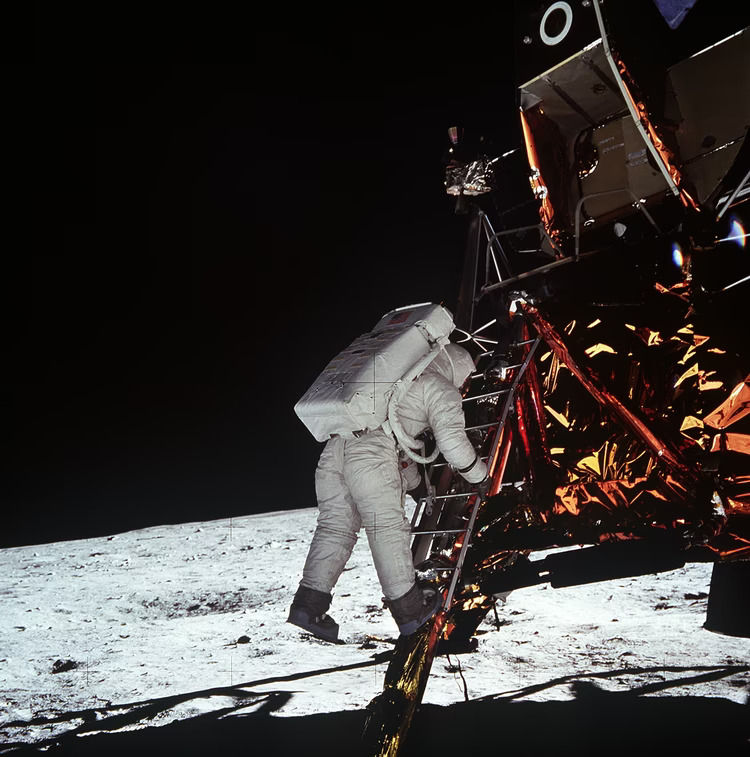
Not because the government told me to. Not because I am naïve about institutional failure. But because the evidence is independent, international, physically retrievable, photographed from lunar orbit by a country that had no reason to protect American prestige, and simply overwhelming.
I believe in the testimony of 400,000 people, many of whom carried their work on that program to their graves as the defining achievement of their lives.
I believe in the Soviet scientists who tracked every Apollo mission and said nothing because there was nothing to say. I believe in the Indian satellite photographs, the moon rocks, the retroreflectors still bouncing laser pulses back to Earth tonight as you read this.
And in the quieter place where faith and reason meet, I believe that we are not without guidance in sorting the true from the fabricated, if we are willing to ask, and to listen, and to be honest about what we find.
So here is something worth pondering:
For millions of people, the belief that the moon landing was faked, or that the Holocaust didn't happen, has become a "truth" reinforced by their social media algorithm, endlessly amplified, socially rewarded, and specifically designed to "stir us up to anger."
Is it possible that the truly counter-cultural act is to follow the evidence wherever it leads, even when the evidence leads somewhere uncomfortable?
And ultimately, is humility essential when it comes to discerning truth?


Comments