

Copies of Copies of Copies
From Soviet censorship to Chinese AI, the battle over narrative intensifies

At a Glance:
In 1990 I visited a Soviet university where students copied American textbooks on an aging photocopier because uncensored information was forbidden. When I recently read a study showing that AI systems developed in China routinely suppress or distort answers to politically sensitive questions, that memory came rushing back. The tools have changed. The determination to control information has not.
In early 2026, artificial intelligence researchers published a study in PNAS Nexus focusing on how different AI systems respond to politically sensitive questions.
The study compared several leading large language models developed inside China with models developed elsewhere.
The results revealed a clear pattern.
When the models were asked politically sensitive questions, the Chinese-developed systems were far more likely to refuse to answer at all. When they did respond, their answers tended to be much shorter or avoided the sensitive subject entirely.
By contrast, when questions aligned with acceptable political narratives, the same models often produced lengthy explanations.
In some cases the models even generated inaccurate responses rather than directly address politically controversial topics.
The researchers noted that these patterns are not surprising given the regulatory environment in which Chinese AI companies operate. As the study explains, “China’s AI regulations are an extension of its censorship regime, which has controlled the flow of information within and into China through explicit interventions to suppress information.”
Responsibility for enforcing those rules is largely delegated to the companies themselves. Technology firms must actively monitor and remove politically sensitive content generated by their systems and ensure compliance with government standards.
As the paper notes, “companies are responsible for monitoring and removing content on their platforms, and are in turn monitored by the Cybersecurity Administration of China (CAC), which may fine or shut down companies for noncompliance.”
In other words, the architecture of these systems does more than generate answers. It also reflects the political boundaries within which those answers must operate.
For anyone who has lived inside a system where information is tightly controlled, this pattern feels all too familiar. When I read that study, it triggered a memory of a small university library in the Soviet Socialist Republic of Lithuania.
An American in the Soviet Union
In December of 1990, I traveled as a student journalist to the city of Kaunas, Lithuania. It was a place that felt suspended between two worlds.
Lithuania had declared independence from the Soviet Union earlier that year, but Moscow rejected it. The Soviet government still claimed authority over the country, and everyone understood that a crackdown could come at any moment.
You could feel the tension everywhere.
The city itself was dim and cold, as if the electrical grid were uncertain about the future. Power outages were common. At times the lights flickered as though the entire city were running on a backup generator that might fail without warning.
I had arrived as part of a delegation of American college students who had collected used textbooks to deliver to Vytautas Magnus University (VMU), the first private university to reopen inside the Soviet Union.
For decades the Soviets had suppressed the university. Now, as Lithuania pushed toward independence, it was being rebuilt almost from scratch.
The first place we visited was the university library.
By American standards it was tiny. Wooden shelves lined the walls, but most of them were empty. Dust collected where books should have been. The room itself was cold, the result of unreliable heating and chronic power shortages.
Students had no textbooks of their own. In many classes only the professor possessed a single copy of a book. Students would gather around it, copying passages or sharing access as best they could.
When American textbooks arrived, something remarkable happened.
Students began copying them on an old Soviet photocopier.
One book would produce a stack of copies. Those copies would produce more copies. Soon the ideas inside those books were spreading across campus through copies of copies of copies.
Each generation of photocopies grew a little lighter and blurrier as each copy was a little worse than the original.
But that didn’t matter.
For many students, this was the first time they had ever seen academic texts that had not been filtered through the Soviet system.
Information itself had become scarce.
A Lesson in English
Our guide and escort at the university was Liucija Baskauskas, the university's deputy rector and chief academic officer, a role similar to a provost at an American university.
Liucija was American. She had been born and raised in the United States and earned her Ph.D. in California. At the time she was a professor of anthropology at California State University, Northridge. Her family, however, was Lithuanian, and she spoke the language fluently.
She had taken a sabbatical from Cal State Northridge to help rebuild VMU and guide it through the process of accreditation so that its courses could eventually be recognized by Western institutions.

One day she handed me a small English textbook used in Lithuanian schools during the Soviet era.
“You might find this interesting,” she said.
The book itself was thin and tattered, printed on flimsy paper like most Soviet books. Liucija flipped to a particular page and pointed to a short reading passage designed to teach English vocabulary to fourth-grade students.
The first paragraph introduced a boy named Sam.

“This is a black boy. His name is Sam. Sam lives in the USA. Sam has no home. He lives in the street. He sleeps in a big box in a park. Sam is not a schoolboy.”
The next paragraph introduced a girl named Laima.
“Laima is a schoolgirl. She is a pioneer. She lives in the Soviet Union. She lives in Palanga. She lives in a green street on a big hill. The house where Laima lives has a big yard. The house has a good garden too. Laima sleeps in her little room. Palanga is by the sea. Laima swims in the sea.”
The contrast was impossible to miss.
An American boy sleeping in a cardboard box in a park.
A Soviet girl living comfortably by the sea with her own room and a garden.
On the surface the lesson seemed almost comical.
But accuracy was never the point.
It was narrative.
What People Knew. And What They Didn’t.
The Soviet system didn’t need citizens to believe every line of propaganda. It only needed to shape the picture people had of the world beyond their borders.
And the easiest way to do that was to control the flow of information.
Many of the students and faculty I met openly acknowledged that Soviet newspapers like Pravda were propaganda. They read them anyway, because those were often the only sources available.
They knew the narrative was distorted.
But they had very few ways to verify what was true.
More importantly, they had no way of knowing how much of the picture was missing. The gaps in their understanding were invisible to them.
That is why the arrival of Western textbooks mattered so much.
What those students understood, perhaps more clearly than anyone, was that access to unfiltered information was not a luxury. It was a form of freedom.
The Man Who Refused the Lie
The Soviet textbooks tried to shape how Lithuanian children understood the outside world. But propaganda did more than distort life in America.
It also rewrote Lithuania’s own history.
According to the Soviet narrative, Lithuania had voluntarily joined the Soviet Union in 1940.
The reality was very different.
During my time in Lithuania I had the rare opportunity to interview Juozas Urbšys, Lithuania’s foreign minister in 1939 and 1940.

Urbšys was no stranger to negotiating under duress. A year earlier, in March 1939, he had sat across the table from the Nazis as Germany demanded Lithuania surrender the Klaipėda region or face military invasion.
In June 1940, he faced a different ultimatum from a different power. He was summoned to Moscow, where Stalin issued an ultimatum: Lithuania would either allow Soviet troops to occupy the country, or face immediate military invasion.
With no realistic military option, Urbšys signed the document allowing Soviet troops to enter the country.
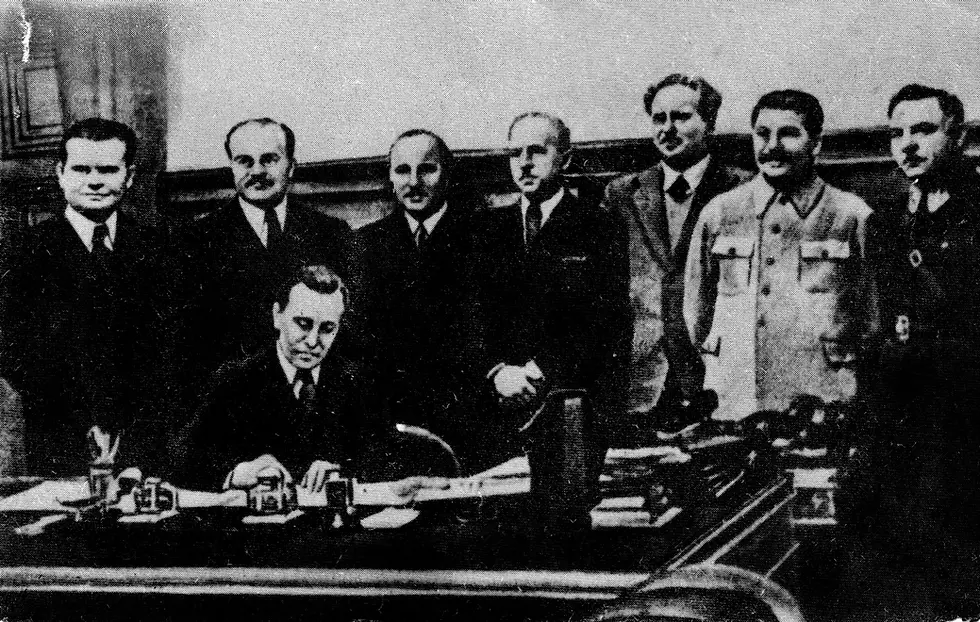
After the signing he sat at dinner with Stalin and Soviet foreign minister Vyacheslav Molotov, making polite conversation as though he had not just been coerced into signing away the sovereignty of his country.
The next day Stalin had Urbšys arrested. For the next thirteen years Urbšys was imprisoned in a Soviet gulag, most of his time was spent in solitary confinement.
When I met him in 1990, Urbšys was ninety-five years old. He spoke with a soft, raspy voice, but his intellect was clear. His memory remained sharp. Despite everything he had endured, he remained defiant in one critical respect: He refused to accept the Soviet version of history.
Lithuania had not voluntarily joined the Soviet Union. It had been occupied.
Three months after our interview, he passed away. I later realized I had been the last foreign journalist to interview him.
Urbšys had spent much of his life exiled within the Soviet system. But even after thirteen years in a gulag, he refused to allow that system to rewrite what had happened to his country.
Narratives can dominate for decades.
But they cannot erase the truth.
Seeing the Effects of the System from the Inside
On that same trip I traveled through Moscow, the capital of the Soviet Union.
I had traveled internationally before and was familiar with a small ritual that sometimes happens when a plane lands in someone’s home country: passengers clap.
It’s a spontaneous expression of pride and relief at returning home.
When our plane landed in Moscow, the cabin was silent.
But when the aircraft lifted off again a few days later, something unexpected happened.
Passengers began to cheer.
It was the first time I had ever seen people celebrate leaving a country.
Lithuania, Then and Now
Nearly thirty years later I returned to Kaunas, Lithuania. I was there to conduct research on a new novel. But everything had changed.
The same streets were now packed with traffic. Restaurants and cafés were busy. Many of the old apartment blocks had been renovated and painted in bright colors.
It was the same city.
But it felt like a completely different world.
During my visit, I had seen what decades of coercive censorship and narrative manipulation looked like from the inside. On my return, I saw what can happen when that control is lifted.
Lithuania still has its problems, like any country. It still has powerful forces that aim to shape and manipulate its historical narrative. But its people are free to disagree, to question, to seek out perspectives beyond what any government would choose to offer them.
The Battle Over Information
When I think back to that library in Kaunas, one idea stays with me.
Students copying textbooks.
Then copying the copies.
Then copying those copies again.
Today we live in a very different information environment. Instead of scarcity, we face an overwhelming abundance of information.
Yet the challenge of understanding the world has not disappeared.
The systems that deliver information (media organizations, search engines, social platforms, artificial intelligence) still shape what we see, what we read, and sometimes what we never encounter at all.
That recent research comparing Chinese versus non-Chinese AI systems is a reminder that governments are still quite determined to control their information and narratives.
The technology may be new. But the underlying struggle is not.
The battle over information did not end with the Cold War.
It simply moved into new arenas.
The tools that shape our understanding of the world may change.
The responsibility to question them never does.


Comments